
Why Your Energy Crashes After Lunch, and the 2,000-Year-Old Spice Researchers Keep Coming Back To
Scientists have published dozens of studies on Ceylon cinnamon and blood sugar, blood pressure, inflammation and digestion. But there's one detail most people get wrong.
It's 2:30 in the afternoon. Lunch was only an hour ago, but your eyelids feel heavy, your focus is gone and somehow you're already thinking about something sweet.
You tell yourself it's just age. Or stress. Or that you didn't sleep well.
But for millions of adults, that daily slump isn't random at all. It follows a very predictable pattern, and once you understand it, you can start working with your body instead of against it.
- Energy that crashes an hour or two after eating
- Cravings for sugar or carbs in the afternoon
- Feeling heavy, bloated or sluggish after meals
- Restless energy: wired one moment, drained the next
- A feeling that your body just doesn't run as smoothly as it used to
If you nodded along to two or more of these, keep reading. What follows isn't a miracle cure. It's what researchers have been learning about one of the oldest spices on earth, and why the kind you take makes all the difference.
The hidden patternWhat Really Happens in Your Body After Every Meal
Every time you eat, especially refined carbs, glucose enters your bloodstream. Your body releases insulin to move that glucose into your cells, where it's turned into energy.
When everything works smoothly, the rise is gentle and so is the fall. But meals heavy in fast carbs can send glucose up quickly, followed by a steep drop. That drop is what many people feel as the afternoon crash: tiredness, brain fog and the sudden urge for something sweet, which starts the cycle all over again.
The spike-and-crash cycle
How energy can feel after a fast-carb meal versus a steadier response
Over time, these swings don't just affect your energy. Researchers increasingly look at blood sugar balance, blood pressure, inflammation and digestion as closely connected parts of the same metabolic picture. That's why so many people notice that when one improves, the others often follow.
A 2,000-year-old answerThe Ancient Spice Scientists Keep Coming Back To
Long before it was a baking spice, cinnamon was one of the most valued substances in the ancient world. It was traded along the spice routes, prized in traditional medicine systems and, for centuries, worth more than gold by weight.
Today it's back in the spotlight for a different reason. Over the past two decades, researchers have published dozens of studies on cinnamon and its natural compounds, such as cinnamaldehyde and cinnamon polyphenols, looking at how they relate to everyday metabolic health.
More than blood sugar4 Ways Ceylon Cinnamon Supports Your Body
What makes cinnamon so interesting to researchers is that its benefits don't stop at blood sugar. Here's what the science and centuries of traditional use point to:
1. Blood sugar balanceSteadier Energy, Fewer Crashes*
By supporting healthy glucose metabolism, Ceylon cinnamon helps support blood sugar levels already within the normal range.* For many people that translates into a more even afternoon, fewer cravings and less of the rollercoaster feeling after meals.
2. Healthy blood pressureSupport for a Healthy Heart*
Vitaela supports blood pressure levels already within a healthy range* as part of a balanced lifestyle. It's not a replacement for medication or medical advice, but a simple daily habit that works alongside healthy choices.
3. A healthy inflammatory responseRich in Natural Antioxidants*
Cinnamon ranks among the most antioxidant-rich spices studied. Its polyphenols and cinnamaldehyde have been shown in laboratory research to help neutralize free radicals and support the body's natural, healthy inflammatory response. [4]
Why does that matter? Ongoing oxidative stress is one of the everyday factors linked to how we age, how we recover and how energetic we feel.
4. Digestive comfortLighter, More Comfortable Digestion*
The catch nobody talks aboutMost Cinnamon Is the Wrong Kind
Here's what most people don't realize: the cinnamon on supermarket shelves, and in many supplements, usually isn't Ceylon at all. It's Cassia, a cheaper, related species.
And Cassia comes with a problem. It naturally contains far higher levels of coumarin, a compound that European food-safety authorities have set a tolerable daily intake for, because high amounts taken regularly may stress the liver in sensitive people. [6,7] According to Germany's Federal Institute for Risk Assessment, a single teaspoon of Cassia can already exceed that limit for a small adult, while Ceylon contains only trace amounts. [7]
Coumarin: Cassia vs. Ceylon
Why the type of cinnamon matters for daily use
If you take cinnamon every day, the type you choose matters as much as the dose. The takeaway from European food-safety guidance
Why nothing you've tried has stuckThe 3 Mistakes in Most Cinnamon Supplements
- Wrong species: cheap Cassia instead of true Ceylon, with far more coumarin.
- Too little: a few hundred milligrams of dry powder per capsule, so you'd need a handful a day.
- Poor absorption: cinnamon's key compounds are fat-soluble, but powder in a capsule gives them nothing to dissolve in.
That's exactly the gap Vitaela was created to close.
The solutionMeet Vitaela: True Ceylon, Done Right
Vitaela takes everything the research points to and puts it into one small softgel:
- 100% true Ceylon cinnamon (Cinnamomum verum) from Sri Lanka, naturally low in coumarin
- 12:1 concentrated extract: one softgel equals 7,200mg of raw Ceylon cinnamon
- Dissolved in MCT oil from coconut, a fat-based carrier for cinnamon's fat-soluble compounds
- Third-party lab tested every batch, non-GMO, gluten-free, no artificial fillers
- One softgel a day with a meal: no powders, no bitter taste, nothing to mix
| Vitaela | Grocery cinnamon | Typical capsules | |
|---|---|---|---|
| True Ceylon (low coumarin) | |||
| Concentrated 12:1 extract | |||
| 7,200mg equivalent per serving | |||
| MCT oil for absorption | |||
| Third-party lab tested | Sometimes | ||
| One serving a day | 2–4 capsules |
What to expectYour First 8 Weeks With Vitaela
- Week 1–2
Build the habit
One softgel a day with a meal. Pair it with something you already do every day, like breakfast or your morning coffee.
- Week 3–4
Notice the rhythm
Many people start paying attention to how their energy feels after meals, and how often they reach for something sweet.
- Week 5–6
Steady support
Consistent daily support for healthy blood sugar levels, digestion and a healthy inflammatory response.*
- Week 8+
Long-term wellness
Naturally low in coumarin, Vitaela is made for daily, long-term use as part of a balanced lifestyle.
Individual experiences vary and depend on your diet, activity and overall health.
Try it without riskToday's Offer: Buy 2, Get 1 Free
We believe the best way to judge Vitaela is to try it for yourself, consistently, for long enough to give it a fair chance. That's why every order is backed by our 90-day money-back guarantee, and why we recommend starting with a 3-bag supply.
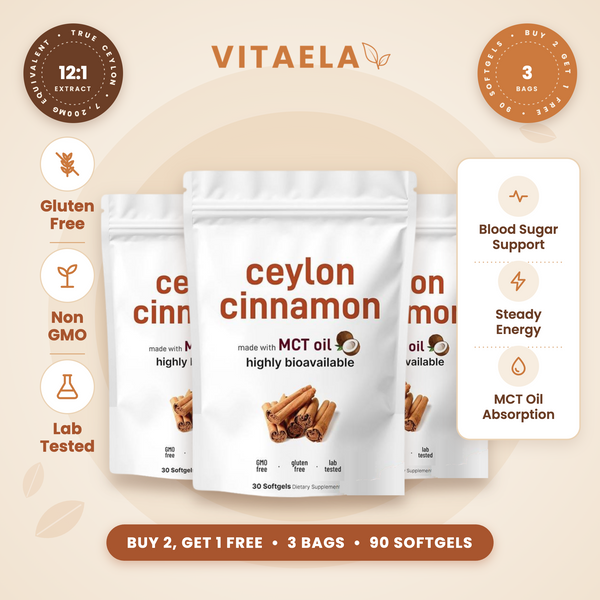
Try Vitaela Ceylon Cinnamon Risk-Free
- True Ceylon, 12:1 extract: 7,200mg equivalent per softgel
- With MCT oil for better absorption
- Save 30% extra with Subscribe & Save, cancel anytime
- Free shipping on the Buy 3, Get 2 Free bundle
90-Day Money-Back GuaranteeTake Vitaela daily for up to 90 days. If you're not satisfied, contact us and we'll refund your purchase.
Good to knowFrequently Asked Questions
What's the difference between Ceylon and Cassia cinnamon?
Ceylon (Cinnamomum verum) is known as true cinnamon and is grown in Sri Lanka. Cassia is a different, cheaper species found in most supermarkets. The biggest difference for daily use is coumarin: Cassia contains much more, Ceylon only trace amounts.
How do I take Vitaela?
Take one softgel a day with a meal. One bag contains 30 softgels, a full 30-day supply.
Can I take it if I'm on medication?
Cinnamon can interact with some medications, including those that affect blood sugar or blood clotting. If you take prescription medication, are pregnant or nursing, or have a medical condition, talk to your doctor before starting Vitaela or any new supplement.
When will I notice a difference?
Everyone is different. Ceylon cinnamon works best as a consistent daily habit alongside balanced meals and regular movement. We recommend giving it at least 60–90 days, which is why every order comes with a 90-day money-back guarantee.
How does the guarantee work?
Take Vitaela consistently. If you're not happy with it within 90 days of your purchase, contact our team and we'll refund you. See our refund policy for full details.
Sources
1. Allen RW, Schwartzman E, Baker WL, Coleman CI, Phung OJ. Cinnamon use in type 2 diabetes: an updated systematic review and meta-analysis. Ann Fam Med. 2013;11(5):452–459.
2. Hlebowicz J, Darwiche G, Björgell O, Almér LO. Effect of cinnamon on postprandial blood glucose, gastric emptying, and satiety in healthy subjects. Am J Clin Nutr. 2007;85(6):1552–1556.
3. Akilen R, Pimlott Z, Tsiami A, Robinson N. Effect of short-term administration of cinnamon on blood pressure in patients with prediabetes and type 2 diabetes. Nutrition. 2013;29(10):1192–1196.
4. Rao PV, Gan SH. Cinnamon: a multifaceted medicinal plant. Evid Based Complement Alternat Med. 2014;2014:642942.
5. European Medicines Agency, Committee on Herbal Medicinal Products. Community herbal monograph on Cinnamomum verum J.S. Presl, cortex.
6. European Food Safety Authority. Coumarin in flavourings and other food ingredients with flavouring properties. EFSA Journal. 2008;793:1–15.
7. German Federal Institute for Risk Assessment (BfR). Frequently asked questions about coumarin in cinnamon and other foods.
This article is an advertisement for Vitaela. Studies referenced above investigated cinnamon in general, often Cassia cinnamon, and do not refer to Vitaela specifically. *These statements have not been evaluated by the Food and Drug Administration. This product is not intended to diagnose, treat, cure, or prevent any disease. Individual results may vary. Consult your healthcare professional before use if you are pregnant, nursing, taking medication or have a medical condition.